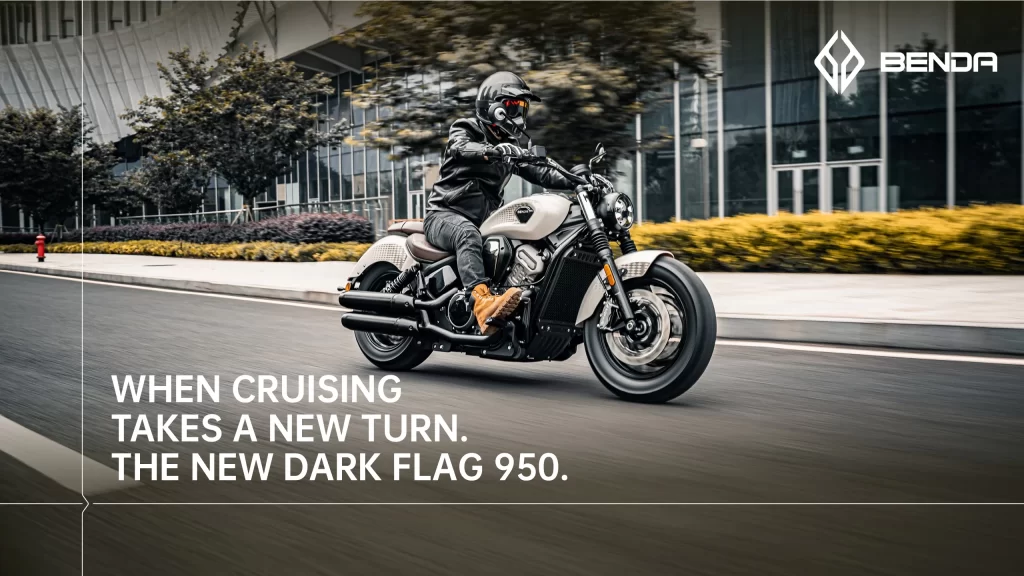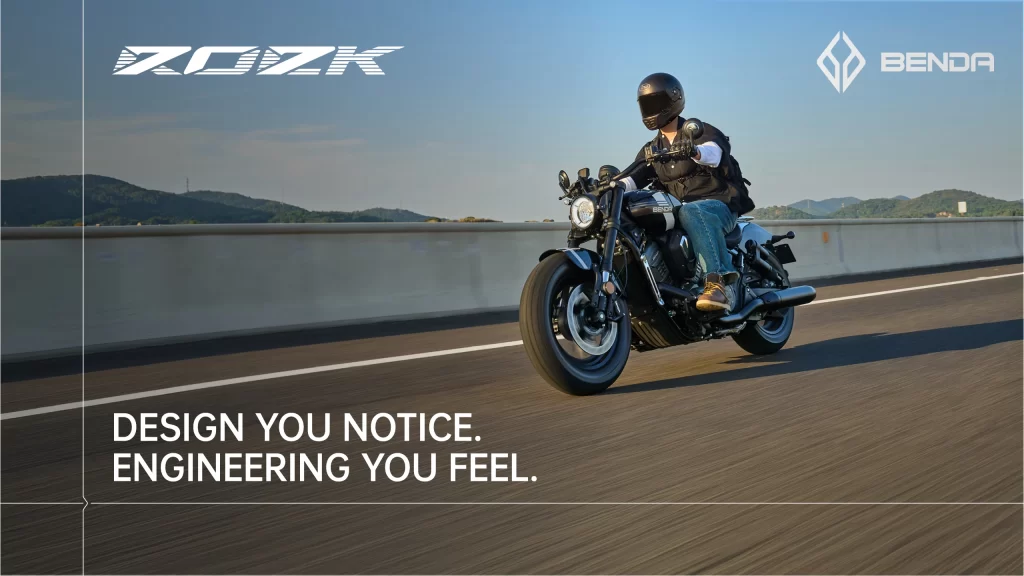
At Benda, we design motorcycles with thoughtful attention to how every component contributes to the ride. With the Benda Dark Flag 500 Commander as a core example of a V4 bike, we explore how mass centralization affects handling and what that means for riders.
What Is Mass Centralization?
Mass centralization refers to concentrating a motorcycle’s weight as close as possible to its center of gravity. On any motorcycle, the way weight is distributed front-to-back and high-to-low shapes how the bike responds to rider inputs in turns, transitions, and straight-line stability. In essence, moving weight inward toward the center of the machine tends to make it more responsive and predictable, while weight far from that point can make the bike resist quick changes in direction.
On a V4 engine motorcycle such as the Dark Flag 500 Commander, the compact nature of the V-configured powerplant already supports efforts toward centralization. Because the cylinders are arranged in a V shape, the engine tends to be narrower than an inline equivalent of similar displacement, allowing us to place other elements such as fuel and rider aids closer to the centerline.
Why Centralized Mass Matters in Handling
When weight is arranged more closely to the bike’s center, several handling characteristics improve. The first is lean-to-lean transition. With centralized mass, it generally takes less effort for the rider to initiate a lean into a corner. This is because the bike’s moment of inertia, whose resistance to rotational acceleration is lower when weight is packed near the center. A centralized mass configuration means less “resistance” to pivoting the bike around its center of gravity, helping the bike feel more agile and confident in direction changes.
Another benefit shows up in pitch control during acceleration and deceleration. When weight is distributed closer to the bike’s center instead of toward the wheels, the sensation of squat under acceleration and dive under braking can be better balanced. This leads to a stable, composed feel whether you’re cruising at highway speed or rolling into a sweeping bend.
However, centralization must be balanced with overall geometry considerations. For example, very low weight distribution around the center can make a bike feel quick to tilt but may slightly reduce stability at very high lean angles. That’s why chassis design, wheelbase length, and suspension geometry all play roles alongside centralization.
Applying Centralization in a V4 Bike Like the Dark Flag 500 Commander
The Dark Flag 500 Commander uses a cradle-type steel frame and a liquid-cooled 496 cc V4 engine, combining a relatively compact power unit with a chassis design that supports a rider-focused center of gravity. We also integrate technologies such as adjustable air suspension and traction control systems that work with the bike’s mass distribution to make handling consistent and predictable.
Even though cruiser-style motorcycles traditionally emphasize relaxed riding rather than sporty cornering, thoughtful attention to mass centralization still enhances how the machine feels under real-world conditions. The goal is not to create an aggressive sportbike performance but to ensure that a mid-displacement V4 engine motorcycle responds smoothly and confidently through varying riding situations.
Conclusion
Mass centralization is a key factor in how a motorcycle handles. By arranging weight close to the center of gravity, riders experience a bike that feels balanced when turning, stable under power, and composed in everyday use. In the case of the Benda Dark Flag 500 Commander, the compact V4 engine configuration helps us achieve this kind of thoughtful weight distribution. By pairing this with chassis and suspension choices suited to cruiser riding, we aim to give riders a motorcycle that feels capable and comfortable on a wide range of roads.